Security Considerations
Path traversal, prompt injection, resource limits, signing, and sensitive data handling.
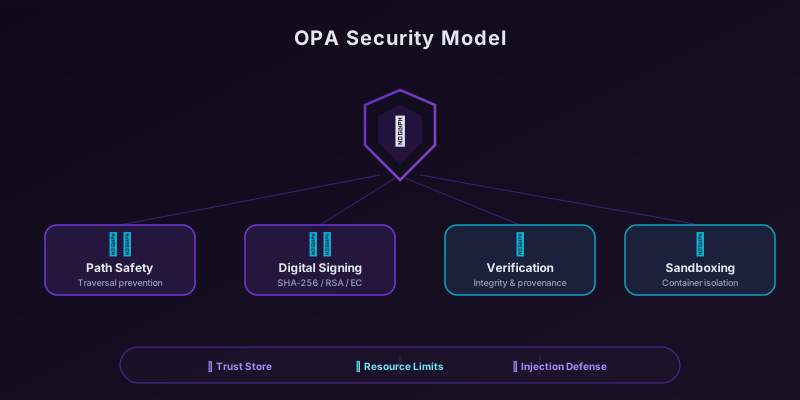
Path Traversal
Clients MUST validate all archive entry paths before extraction (see File Format — Path Safety). Any path containing .. or beginning with / MUST cause the client to reject the archive.
Prompt Injection
Session history and data assets are user-supplied content and MUST be treated as untrusted by the client.
Clients SHOULD inform users when executing archives from unknown sources. Agents SHOULD be instructed not to follow instructions embedded in data assets that conflict with the primary prompt.
Resource Limits
Clients operating in autonomous mode MUST enforce maximum turn counts and token budgets to prevent runaway execution.
Recommended Defaults
| Limit | Value |
|---|---|
| Maximum turns | 50 |
| Maximum tokens | 200,000 |
Signing
OPA archives support digital signing following the JAR signing convention. Signing allows archive consumers to verify the identity of the author and the integrity of the archive contents.
Signature Files
A signed archive MUST contain a signature file and a signature block file in the META-INF/ directory:
| File | Description |
|---|---|
META-INF/SIGNATURE.SF |
The signature file. Contains digests of the manifest and its individual sections. |
META-INF/SIGNATURE.RSA, .DSA, or .EC |
The signature block file. Contains the PKCS #7 digital signature of SIGNATURE.SF. The extension indicates the algorithm used. |
Signature File Format
The signature file (SIGNATURE.SF) follows the JAR .SF format:
Signature-Version: 1.0
Created-By: opa-cli 1.0.0
SHA-256-Digest-Manifest: <base64-encoded digest of entire MANIFEST.MF>

Name: prompt.md
SHA-256-Digest: <base64-encoded digest of the prompt.md section in MANIFEST.MF>

Name: data/report.csv
SHA-256-Digest: <base64-encoded digest of the data/report.csv section in MANIFEST.MF>
The main section MUST include Signature-Version: 1.0 and a digest of the entire manifest file. Each individual section contains a digest of the corresponding named section in META-INF/MANIFEST.MF.
Digest Algorithms
Implementations MUST support SHA-256. Implementations MAY additionally support SHA-384 and SHA-512. Implementations MUST NOT accept MD5 or SHA-1 digests.
Verification
Clients MUST verify signatures when all of the following are true:
- The archive contains a
META-INF/SIGNATURE.SFfile. - A corresponding signature block file (
META-INF/SIGNATURE.RSA,.DSA, or.EC) is present.
Verification proceeds as follows:
- Verify the digital signature in the signature block file against
SIGNATURE.SF. - Verify that the manifest digest in
SIGNATURE.SFmatches the actualMANIFEST.MFcontents. - For each named entry in
SIGNATURE.SF, verify that the section digest matches the corresponding section inMANIFEST.MF.
If any verification step fails, the client MUST reject the archive.
Clients SHOULD NOT execute unsigned archives in
autonomousmode unless the user has explicitly opted in. Signed archives provide stronger guarantees about provenance and integrity.
Trust
Clients MUST maintain a trust store of accepted certificates or public keys. The mechanism for managing the trust store (e.g., configuration file, system keychain, command-line flags) is implementation-defined.
Clients MAY support a
--trust-unsignedor equivalent flag to allow execution of unsigned archives. This flag SHOULD default to disabled.
Sensitive Data
Archives MAY contain sensitive data. Authors SHOULD encrypt archives containing credentials, PII, or proprietary information.
The core format does not mandate encryption; an encryption extension is anticipated.