Execution Model
Client responsibilities, execution modes, output conventions, and environment variables.
Client Responsibilities
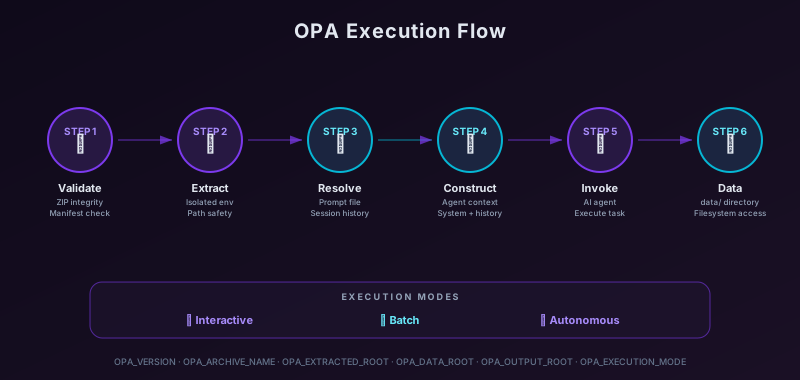
A conformant client MUST:
- Validate the archive (ZIP integrity, manifest presence, OPA-Version recognition).
- Extract the archive into an isolated environment.
- Resolve the prompt file and session history per the manifest.
- Construct the agent context: system messages (if any) → session history messages → prompt.
- Invoke the agent with the constructed context.
- Provide the
data/directory to the agent via the container filesystem or equivalent mechanism.
Execution Modes
| Mode | Behaviour |
|---|---|
interactive |
Client presents agent responses to the user in real time; user may send follow-up messages. Session history SHOULD be updated by the client. |
batch |
Client runs the prompt to completion without user interaction. Output is captured and SHOULD be written to output/ within the container. |
autonomous |
Agent may invoke tools and loop until a terminal condition is met. Client MUST enforce a configurable turn or token limit. |
The execution mode is specified in the manifest via the Execution-Mode field. If not specified, the default is interactive.
Output Convention
Clients operating in batch or autonomous mode SHOULD write agent output to an output/ directory inside the container at $OPA_OUTPUT_ROOT.
Clients MAY package the output directory back into a new OPA archive with an updated session history for chaining.
Environment Variables
Clients MUST set the following environment variables in the container:
| Variable | Value |
|---|---|
OPA_VERSION |
The OPA-Version from the manifest. |
OPA_ARCHIVE_NAME |
The base filename of the archive (no extension). |
OPA_EXTRACTED_ROOT |
Absolute path to the extracted archive root. |
OPA_DATA_ROOT |
Absolute path to the extracted data/ directory. |
OPA_OUTPUT_ROOT |
Absolute path to the designated output directory. |
OPA_EXECUTION_MODE |
The resolved execution mode. |
Reference Implementation
A minimal client implementation MUST:
- Accept a path to a
.opafile. - Extract the archive to a temporary directory with path-safety validation.
- Parse
META-INF/MANIFEST.MF. - Read
prompt.md(or the value ofPrompt-File). - If
session/history.jsonexists, parse and prepend it to the agent context. - Invoke the configured agent with the full context.
- Set the required environment variables.
A reference CLI implementation (opa-run) and a Java library (opa-core) are planned as companion deliverables to this specification.